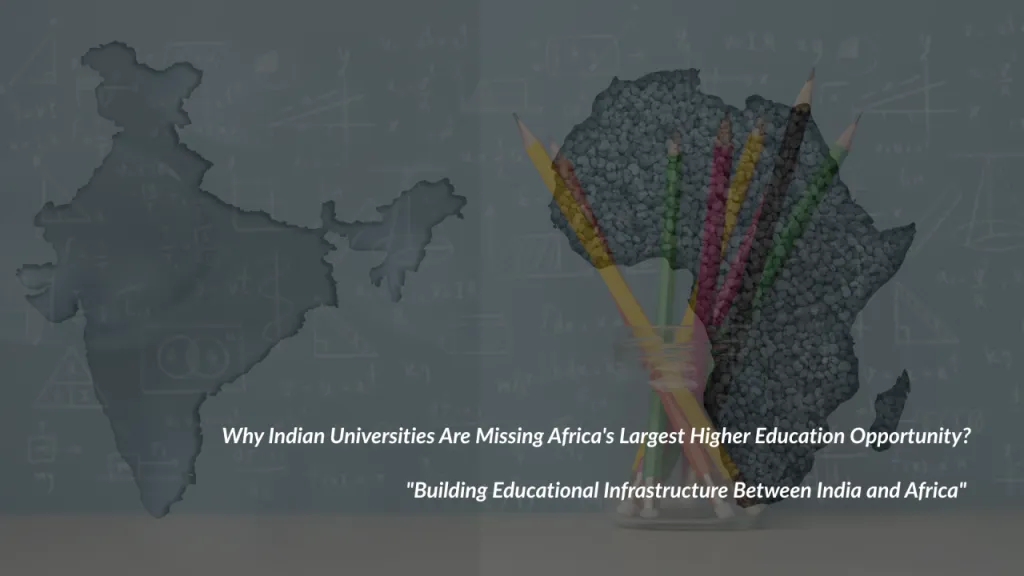
Indian Universities Are Not Losing International Students Because of Marketing. They Are Losing Them Because of Missing Infrastructure
Over the last few months, we have had the privilege of visiting several universities across India and engaging with international admissions teams, institutional leaders, recruitment partners, and policymakers.
What we discovered was surprising.
Most universities are working hard to attract international students.
Yet very few are building the infrastructure required to attract them sustainably.
The challenge facing Indian higher education today is not a lack of ambition.
It is a lack of visibility, trust, and long-term presence in the communities where future students live.
The Industry Is Solving the Wrong Problem
Most universities believe their challenge is straightforward:
"How do we get more international student admissions?"
As a result, institutions invest heavily in:
-
International travel
-
Education fairs
-
Agent networking
-
Delegation visits
-
Government sponsorship programs
While these activities generate admissions, they rarely create long-term market presence.
The real question universities should be asking is:
How do we become visible and trusted before students even begin searching for a university?
Because by the time a student submits an application, much of the decision-making has already happened.
The universities that win globally are not merely present when students apply.
They are present when students begin dreaming.
The Invisible Competition
Many universities believe they are competing against other universities.
They are not.
A student in Rwanda, Kenya, Uganda, Zambia, Ghana, Tanzania, or Nigeria is not comparing ten Indian universities.
Most students are first deciding whether they should study abroad at all.
Then they compare destinations.
India is competing against:
-
China
-
Turkey
-
Malaysia
-
South Africa
-
Europe
-
The Middle East
And sometimes against the option of staying home.
The greatest competitor facing Indian universities is not another institution.
It is invisibility.
You cannot recruit students from communities that do not know you exist.
The Scholarship Dependency Trap
One of the most common patterns I observed is the industry's dependence on government-sponsored students.
Many institutions have built their international strategies around scholarship programs and government partnerships.
There is nothing wrong with sponsorship-driven admissions.
However, sponsorship markets are finite.
The long-term opportunity lies elsewhere.
Across Africa, there is a rapidly growing population of families willing to invest in education when they clearly understand:
-
The value of the qualification
-
Career outcomes
-
Return on investment
-
Employability opportunities
-
Safety and support systems
These families are not waiting for scholarships.
They are waiting for confidence.
Yet very few institutions are investing in creating that confidence.
Instead of educating students and parents, many universities continue investing in activities designed to acquire students after decisions have already been made.
The Question Nobody Is Asking
If universities have been travelling to the same countries for ten years, why do they still need to introduce themselves every time they arrive?
This question reveals the real challenge.
Awareness has not been institutionalized.
Trust has not been built systematically.
Community relationships have not been developed at scale.
Without these foundations, recruitment becomes a never-ending cycle of travel, exhibitions, and dependency on intermediaries.
The result is predictable.
Universities continue spending more money to achieve similar outcomes.
Africa Does Not Have a Student Shortage
Africa has an information shortage.
The continent is home to one of the world's youngest populations.
Millions of young people aspire to pursue quality higher education and build meaningful careers.
The challenge is not demand.
The challenge is access to trusted information.
Many students know little about India's strengths in:
-
Engineering
-
Healthcare
-
Pharmacy
-
Technology
-
Business education
-
Research opportunities
Many parents have never been engaged in meaningful conversations about studying in India.
Many schools lack structured exposure to international higher education pathways.
This is not a student problem.
It is an ecosystem problem.
Why Educational Infrastructure Matters
Industry-ready talent does not emerge at the point of admission.
It emerges from ecosystems.
Students become better prepared when they have access to:
-
Career awareness
-
Mentorship
-
Exposure
-
Guidance
-
Industry insights
-
Informed decision-making
Universities often ask how they can attract better students.
A more powerful question is:
How can universities participate earlier in the student's journey?
The institutions that answer this question will build stronger brands, attract higher-quality applicants, and create deeper impact.
The Future Belongs to Infrastructure Builders
The future of international student recruitment will not be won by institutions that travel the most.
It will be won by institutions that contribute the most.
The universities that succeed over the next decade will be those willing to invest in:
-
School engagement
-
Parent education
-
Community awareness
-
Career readiness
-
Long-term partnerships
-
Student success ecosystems
Admissions will follow naturally.
Because admissions are not the business.
Educational infrastructure is the business.
Admissions are simply the outcome.
Why We Started Building Maarifaa
This realization is one of the reasons we started building Maarifaa.
Not as another recruitment platform.
Not as another agent network.
But as a knowledge-sharing ecosystem connecting students, schools, parents, counselors, institutions, and industry.
Our belief is simple.
When awareness increases, trust increases.
When trust increases, applications increase.
When applications increase, admissions follow.
The question for Indian universities is no longer whether Africa represents an opportunity.
The question is whether institutions are willing to invest in building the infrastructure necessary to serve that opportunity sustainably.
Those who do will not merely recruit students.
They will shape the future of education across continents.
Africa does not have a student shortage.
It has an information shortage.
And Indian universities do not have an admissions problem.
They have an infrastructure problem.
The institutions that continue to chase admissions will compete for the same limited pool of students year after year.
The institutions that invest in awareness, trust, schools, parents, career readiness, and community engagement will shape the future of international education.
The question is no longer whether Africa represents an opportunity for Indian higher education.
The question is whether we are willing to build the educational infrastructure required to serve that opportunity sustainably.
What are your thoughts? Are universities investing enough in long-term ecosystem building, or are we still measuring success through short-term recruitment activities?
#BridgesOfChange #Maarifaa #HigherEducation #StudyInIndia #Africa #InternationalEducation #StudentMobility
Share your thoughts
Team Maarifaa