JEE Explained for African & NRI Students in Rwanda & Africa
A Complete Guide for Students Like Serah Who Dream of Becoming Engineers in India
Every year, thousands of students across the world dream of becoming engineers. Some want to build software, some want to work on Artificial Intelligence and Machine Learning, while others dream of creating technologies that can change the future.
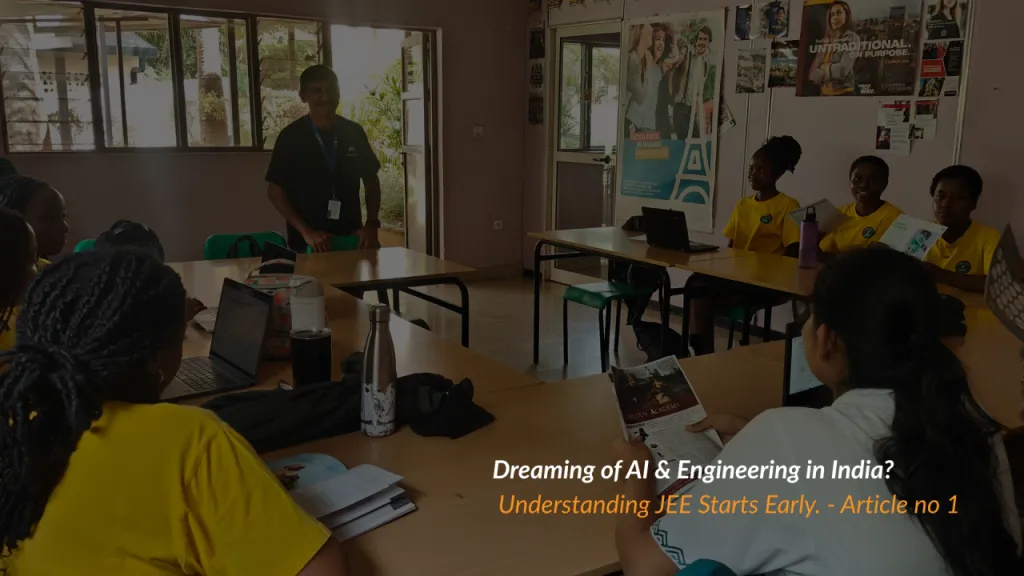
Today in Rwanda, we met Serah, a Senior 5 student who wants to pursue Computer Science Engineering with specialization in AI & ML in India. Her biggest question was simple but important:
“What exactly is JEE? Is it compulsory for all universities in India? How should I prepare from now itself?”
At Maarifaa, we believe knowledge should reach students early not after they complete school, but while they are still building their dreams. This article is written for students like Sarah and many African and NRI students who want to prepare early and confidently for engineering admissions in India.
What is JEE?
Joint Entrance Examination (JEE) is India’s national engineering entrance examination for admission into top engineering institutions.
JEE is mainly divided into two stages:
1. JEE Main
This is the first level examination.
It is conducted by the National Testing Agency (NTA).
Students use JEE Main scores for:
-
Admission into NITs (National Institutes of Technology)
-
IIITs (Indian Institutes of Information Technology)
-
Some centrally funded universities
-
Qualification for JEE Advanced
2. JEE Advanced
This is the second and more competitive level.
Only students who qualify in JEE Main can write JEE Advanced.
This exam is mainly for admission into the prestigious Indian Institutes of Technology (IITs).

Is JEE Compulsory for All Engineering Universities in India?
This is one of the most important things Sarah wanted to understand.
The answer is:
No — JEE is NOT compulsory for all universities in India.
India has different categories of universities, and each follows different admission systems.
Types of Engineering Universities in India
1. IITs (Indian Institutes of Technology)
-
JEE Main + JEE Advanced are compulsory
-
Extremely competitive
-
Best for students aiming for elite engineering careers
Examples:
-
IIT Bombay
-
IIT Delhi
-
IIT Madras
2. NITs and IIITs
-
JEE Main is compulsory
-
No separate university exam
These are highly respected public engineering institutions.
3. Private Universities
Many private universities:
-
Accept JEE Main scores OR
-
Conduct their own entrance exams OR
-
Give direct admission based on school marks
This is extremely important for international students.
Many good private universities provide:
-
International admission support
-
Scholarships
-
Flexible eligibility pathways
Examples include:
-
VIT University (VITEEE Exam)
-
SRM Institute of Science and Technology (SRMJEEE)
-
Manipal Academy of Higher Education (MET Exam)
-
Lovely Professional University (LPUNEST)
Some universities may even waive entrance exams for international applicants depending on:
-
Academic scores
-
Curriculum
-
Country eligibility
-
Interview performance
What Subjects Should Students Focus On?
For JEE preparation, students must strongly focus on:
-
Mathematics
-
Physics
-
Chemistry
These three subjects form the entire foundation of JEE.
When Should Students Start Preparing?
The best time is:
Senior 4 / Grade 10 or Senior 5 / Grade 11
Why?
Because JEE is concept-based, not memorization-based.
Students who start early:
-
Understand concepts deeply
-
Build problem-solving ability
-
Manage pressure better
-
Improve speed and accuracy
JEE Exam Pattern
JEE Main Structure
Subjects
-
Physics
-
Chemistry
-
Mathematics
Mode of Exam
-
Computer-based online examination
Question Types
-
Multiple Choice Questions (MCQs)
-
Numerical value questions
Duration
-
Usually 3 hours
JEE Main Attempts
Students can usually attempt:
-
Two sessions every year
-
January session
-
April session
Best score is generally considered.
JEE Advanced Structure
More analytical and difficult than JEE Main.
Focus areas:
-
Logical thinking
-
Deep conceptual understanding
-
Multi-step problem solving
Important Timeline for Students
Senior 5 (Grade 11)
This is the foundation year.
Students should:
-
Strengthen concepts
-
Start solving practice questions
-
Learn time management
-
Build consistency
Senior 6 (Grade 12)
This becomes the serious preparation year.
Students should:
-
Take mock tests
-
Practice previous papers
-
Revise consistently
-
Apply to universities
Can International Students Write JEE?
Yes.
International and NRI students can write JEE examinations if they meet eligibility requirements.
However, many international students also choose:
-
Private universities
-
International admission pathways
-
Direct admission systems
This reduces pressure while still allowing access to quality engineering education in India.
What About AI & Machine Learning?
Sarah specifically wants:
Computer Science Engineering with AI & ML specialization
This is one of the fastest-growing fields globally.
Indian universities now offer:
-
Artificial Intelligence
-
Machine Learning
-
Data Science
-
Robotics
-
Cybersecurity
-
Cloud Computing
Career opportunities include:
-
Software Engineering
-
AI Research
-
Data Analytics
-
Automation
-
Product Development
-
Startup Entrepreneurship
Best Preparation Strategy for Students in Rwanda & Africa
1. Build Strong Fundamentals
Do not memorize formulas without understanding.
2. Practice Daily
Even 2–3 hours consistently matters more than random long study sessions.
3. Use Online Learning Platforms
Recommended:
4. Solve Previous Year Papers
This helps students understand:
-
Exam patterns
-
Speed
-
Accuracy
-
Question difficulty
Important Advice from Maarifaa
Do not wait until university applications open before learning about engineering admissions.
Many students lose opportunities because:
-
They start late
-
They do not understand entrance exams
-
They are unaware of timelines
-
They underestimate preparation requirements
Preparation is not pressure. Preparation is clarity.
At Maarifaa, our mission is not only helping students join universities but helping them understand the entire journey early enough to make informed decisions.
For students like Sarah, the dream is not just getting admission. The dream is becoming ready for the future they want to create.
Helpful Official Links