
Understanding the UGC Equivalency Certificate: What Every African Student Planning to Study in India Must Know
Every year, thousands of students across Africa dream of studying in India. Some aspire to become doctors, engineers, pharmacists, entrepreneurs, scientists, or business leaders. India continues to attract African students because of its affordable education, globally recognized universities, English-medium instruction, cultural diversity, and strong academic ecosystem.
Yet, while many students focus on university admissions, scholarships, visas, and travel, one important requirement is often overlooked until the last minute the Equivalency Certificate.
Recently, India introduced a major change in how foreign qualifications are recognized. This is something every African student, parent, counselor, recruitment partner, and university must clearly understand.
Earlier, equivalency recognition was mainly handled by the (AIU). However, under the latest regulations introduced in 2025, the (UGC) has now become the official statutory authority responsible for granting equivalence to foreign qualifications in India.
This change is important because it directly impacts how African students use their qualifications for higher education opportunities in India.
Official Portal:
Why This Matters for African Students
Across many African countries, students complete education through different examination systems and national curricula.
For example:
-
WAEC
-
NECTA
-
KCSE
-
UNEB
-
CAPS
-
Cambridge curriculum
-
IB curriculum
-
Francophone systems
-
National university systems
When these students apply to Indian universities, Indian authorities must determine whether those qualifications are academically comparable to Indian standards.
This is where the Equivalency Certificate becomes important.
It officially confirms that:
“The student’s foreign qualification is recognized and academically equivalent to an Indian qualification.”
Without proper equivalency recognition, students may face:
-
admission delays,
-
registration issues,
-
document verification challenges,
-
or confusion during enrollment.
Why India Introduced the New UGC Equivalency System
India is rapidly expanding its international education ecosystem. African students today form one of the most important international student communities in Indian universities.
As student mobility increased, India identified the need for:
-
a more transparent system,
-
faster processing,
-
national standardization,
-
legal clarity,
-
and stronger academic governance.
Under the new “UGC (Recognition and Grant of Equivalence to Qualifications obtained from Foreign Educational Institutions) Regulations, 2025,” the process is now governed directly by UGC.
This is part of India’s broader vision under:
-
internationalization of education,
-
and strengthening global academic collaboration.
For African students, this creates a more structured and nationally recognized pathway for qualification recognition.
Official UGC Website:
What Exactly is an Equivalency Certificate?
An Equivalency Certificate is an official academic recognition document issued by UGC.
It confirms that:
-
a student’s school qualification,
-
diploma,
-
bachelor’s degree,
-
or postgraduate degree
obtained outside India is academically comparable to an Indian qualification.
For example:
See content credentials
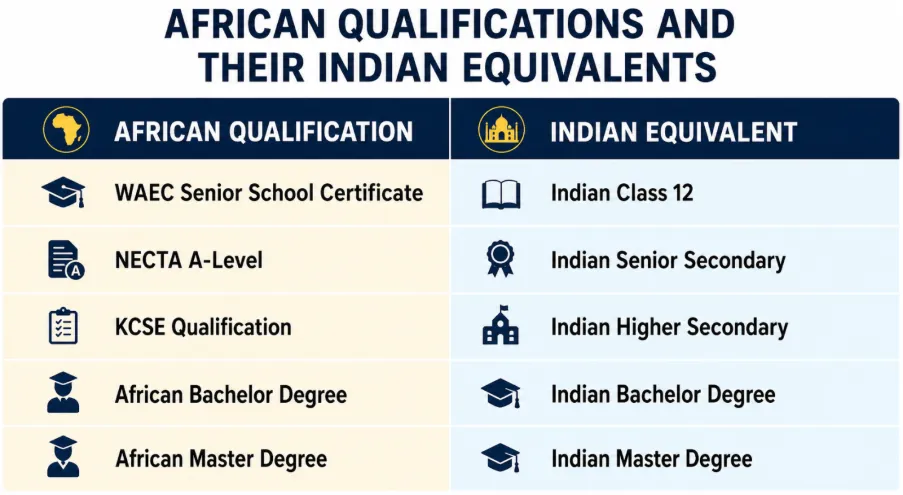
Image generated on ChatGPT
This helps Indian universities determine student eligibility accurately.
Who Needs This Certificate?
African students may require equivalency recognition if they are:
-
applying to Indian universities,
-
pursuing postgraduate education,
-
transferring academic credentials,
-
applying for research programs,
-
or using foreign qualifications for academic progression in India.
This is especially relevant for students coming from:
-
Rwanda
-
Kenya
-
Uganda
-
Tanzania
-
Nigeria
-
Ghana
-
Zambia
-
Zimbabwe
-
Ethiopia
-
South Africa
-
Malawi
-
Cameroon
-
and many other African nations.
Important Clarification for Medical and Professional Courses
This is one area where many students become confused.
The UGC equivalency framework applies mainly to general academic qualifications. However, certain professional courses are regulated separately by statutory councils in India.
These include:
-
Medicine
-
Nursing
-
Pharmacy
-
Law
-
Architecture
For example:
-
Medical education in India is regulated by the (NMC)
-
Pharmacy education is regulated by the (PCI)
-
Legal education is regulated by the (BCI)
-
Nursing education is regulated by the (INC)
-
Architecture education is regulated by the (COA)
This means African students pursuing MBBS or other professional programs may need additional regulatory compliance beyond equivalency recognition.
This is why students should begin understanding these requirements early not after admission deadlines approach.
What Does UGC Evaluate?
Before granting equivalency, UGC evaluates:
-
whether the institution is officially recognized in its home country,
-
academic structure,
-
course duration,
-
curriculum standards,
-
learning outcomes,
-
mode of study,
-
and qualification framework.
If the institution is not properly accredited or recognized, equivalency may be denied.
This is why African students should always ensure they study through recognized institutions and examination boards.
Step-by-Step Process for African Students
Step 1 — Visit the Official UGC Portal
Students should begin only through the official government portal.
Step 2 — Create an Account
Students register using:
-
Email ID
-
Mobile number
-
Passport details
Step 3 — Fill Academic Information
Students provide:
-
Country
-
Institution name
-
Qualification title
-
Duration of study
-
Year of completion
-
Mode of study
Accuracy is extremely important.
Step 4 — Upload Required Documents
Commonly required documents include:
-
Passport copy
-
Academic certificates
-
Transcripts/mark sheets
-
School completion certificates
-
Translation documents (if needed)
-
Proof of institutional recognition
Students should ensure documents are:
-
clear,
-
readable,
-
and properly scanned.
Step 5 — Pay Fees
The application process is digital, and payment is made through the official portal.
Students should always verify current charges directly through official UGC platforms.
Step 6 — Academic Review
UGC’s Standing Committee evaluates:
-
academic comparability,
-
institutional legitimacy,
-
learning outcomes,
-
and qualification equivalence.
Step 7 — Certificate Issued
If approved:
-
the equivalency certificate is issued digitally.
Students can then use it for:
-
admissions,
-
university registration,
-
higher studies,
-
and academic verification.
Common Mistakes African Students Should Avoid
Waiting Until the Last Minute
Many students apply only after universities request the certificate, causing delays in registration.
Submitting Incomplete Documents
Missing transcripts or unclear scans slow down processing.
Using Unrecognized Institutions
Students must ensure their previous institution is officially recognized in their home country.
Depending on Unofficial Information
Students should always rely on official UGC and university communication.
A Bigger Reflection: Education Mobility Between Africa and India
The growing educational relationship between Africa and India is creating new opportunities for youth across the continent.
However, beyond admissions and scholarships, students also need awareness about:
-
documentation,
-
academic recognition,
-
qualification equivalency,
-
visas,
-
professional regulations,
-
and long-term academic planning.
The new UGC equivalency framework represents India’s effort to build a more globally aligned, transparent, and trusted higher education ecosystem for international students.
For African students, this is not just about paperwork. It is about ensuring that their educational journey into India begins with clarity, preparedness, and confidence.
Final Thoughts
Many African students have the aspiration to study in India, but awareness about critical academic processes is still limited. Understanding the equivalency process early can save students from confusion, delays, and unnecessary stress later in their journey.
As India continues to strengthen its role as a global education destination, systems like the UGC Equivalency Framework will play an important role in supporting smoother academic mobility and stronger educational collaboration between Africa and India.
The key message for every student is simple:
Start early. Stay informed. Use official sources. Prepare beyond admission.
Because studying abroad is not just about securing a university seat — it is about understanding the entire journey ahead.
Useful Official Links
UGC Equivalence Portal
University Grants Commission
National Medical Commission
Explore Maarifaa by clicking the link here
Team Maarifaa